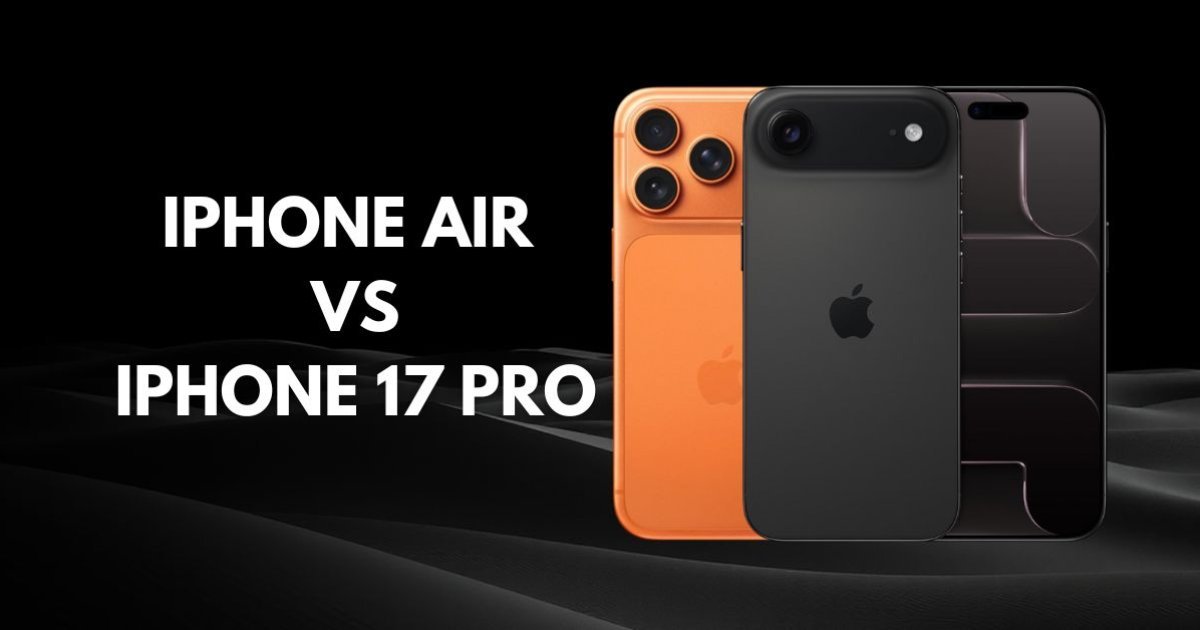
iPhone Air vs iPhone 17 Pro
iPhone Air vs iPhone 17 Pro: Style vs. Power in 2026
In January 2026, the iPhone lineup reached its most diverse point in history. Gone are the days when "bigger" simply meant "better." With the recent launch of the iPhone Air (often called the iPhone 17 Air), Apple has introduced a third category that sits between the standard models and the Pro powerhouses.
If you are standing in an Apple Store today, you are likely looking at two phones with very similar price tags but completely different philosophies. One is a 5.6mm engineering marvel designed for the minimalist; the other is a triple-camera beast designed for the professional. Let’s break down which one deserves your investment.
1. The Design: 5.6mm vs. 8.7mm
The iPhone Air is, quite literally, the thinnest iPhone ever made. At just 5.6mm, it feels like you’re holding a piece of glass from the future. It’s significantly thinner than the iPhone 17 Pro (8.7mm) and light enough to disappear in your pocket.
The iPhone 17 Pro, by contrast, feels "dense." While it also uses a Titanium frame, it is packed with cooling systems and camera hardware that give it a substantial, reassuring heft.
The 2026 Reality: The Air is the phone people ask to hold at a dinner party. The Pro is the phone you rely on to get the work done. If you value portability and "pocketability" above all else, the Air is undefeated.
2. Display: 6.5" vs. 6.3"
Surprisingly, the thinner phone has the larger screen.
- iPhone Air: Features a 6.5-inch display. It’s the middle ground between the Pro and the Pro Max.
- iPhone 17 Pro: Stays at a compact 6.3-inch display.
Both phones now feature ProMotion (120Hz) and Always-On technology. In 2026, Apple finally brought high refresh rates to the non-Pro specialty models. Both screens hit a staggering 3,000 nits of peak brightness, making them equally readable under the harshest midday sun.
3. The Camera: Single Lens vs. The Triple Threat
This is the "dealbreaker" section. To achieve that 5.6mm thinness, Apple had to make a sacrifice: the camera.
- iPhone Air: Has a single 48MP Fusion camera. While it uses "sensor cropping" to give you a decent 2x zoom, you have no Ultra-Wide and no dedicated Telephoto lens.
- iPhone 17 Pro: Features the full "Pro" suite, a 48MP Main, a 48MP Ultra-Wide, and a 48MP Telephoto lens with 5x or 8x optical zoom.
If you are a photographer, the Air will feel like a step backward. If you’re a casual "point-and-shoot" user who mostly takes photos of people and food for social media, the Air’s single high-quality lens is actually more than enough.
4. Performance: A19 Pro (with a catch)
Both phones use the latest A19 Pro chip, but they aren't identical. The iPhone 17 Pro features the "full" version of the chip with a 6-core GPU and a Vapor Chamber cooling system. This allows it to run heavy games and AI tasks for hours without slowing down.
The iPhone Air uses a slightly modified A19 Pro. To keep the phone from getting too hot in its thin chassis, it has one fewer GPU core and relies on graphite sheets for cooling. It’s still incredibly fast, but if you’re a hardcore mobile gamer playing Genshin Impact at max settings, the Pro is the smarter choice.
5. Battery Life: The Thinness Tax
Physics is undefeated. A thinner phone means a smaller battery.
- iPhone 17 Pro: Rated for up to 33 hours of video playback.
- iPhone Air: Rated for 27 hours.
In 2026, 27 hours is still "all-day" battery life for most people. However, if you are a power user who spends hours on 5G or recording 4K video, the Air will likely need a MagSafe battery pack (which Apple conveniently sells) by 6:00 PM.
A Brief Tangential Thought
Isn't it interesting that the iPhone Air feels like the spiritual successor to the original MacBook Air? Everyone complained about the lack of ports and the single speaker on that first laptop, yet it eventually became the most popular computer in the world. I suspect the iPhone Air is headed for the same destiny. (Rhetorical question: Are we finally moving past the era of "camera bumps" that look like stove-top burners?) Compare side-by-side.
The Verdict: Which is for you?
Choose the iPhone Air if:
- You are tired of heavy, bulky phones.
- You primarily use your camera for standard shots (1x and 2x).
- You want the most "fashion-forward" and futuristic design Apple offers.
Choose the iPhone 17 Pro if:
- You are a "Power User" who needs the best battery and cooling.
- You need the versatility of an Ultra-Wide and Telephoto lens.
- You prefer the ruggedness and "heft" of a more traditional flagship.